Stages of Faith- Part 3
Summary
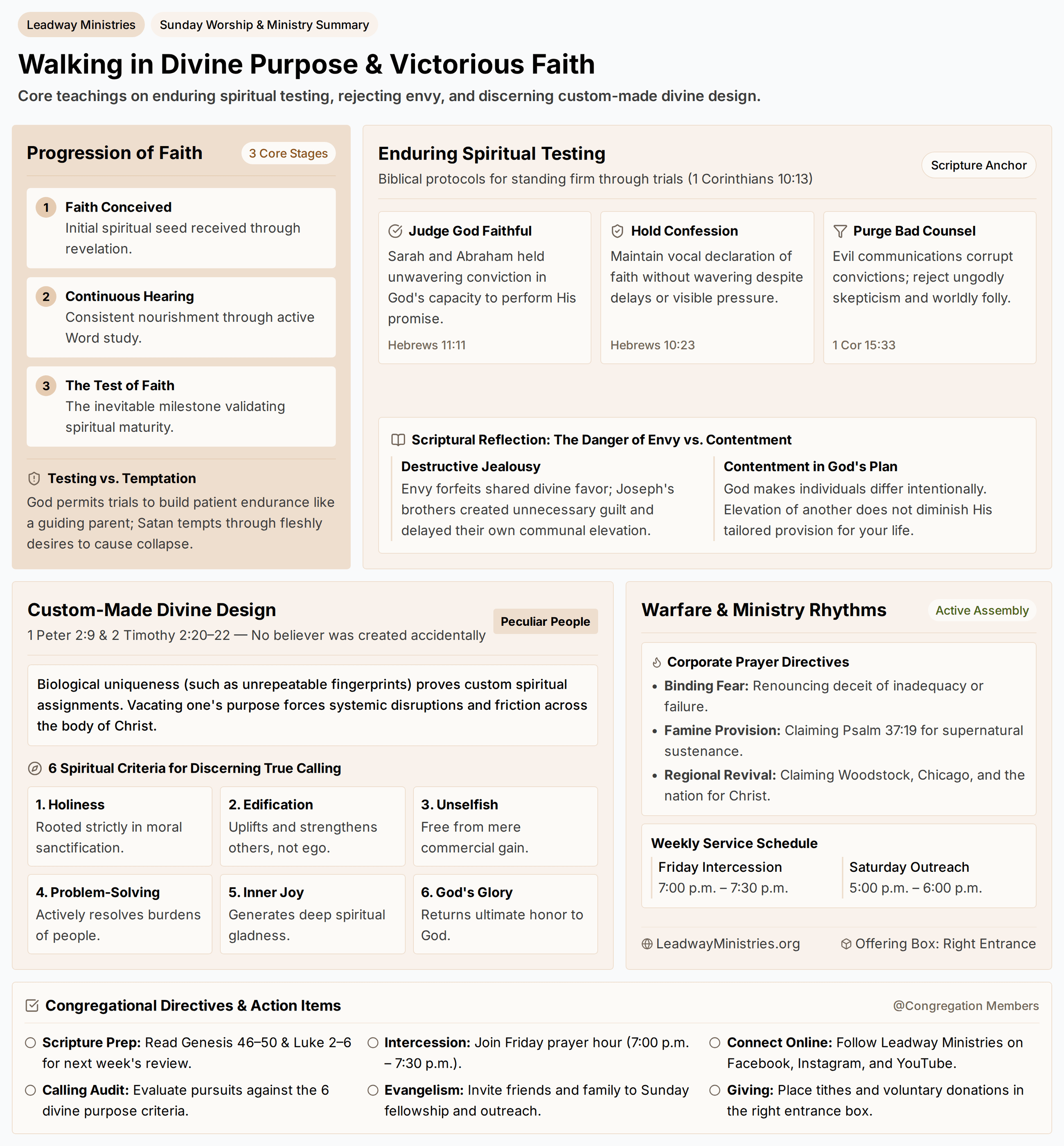
In this teaching, Pastor B explores the testing of faith and the importance of fulfilling God’s purpose. Drawing on the lives of Joseph, Abraham, Sarah, and Job, he encourages believers to avoid envy, trust God’s faithfulness, and guard their faith during difficult seasons.
Pastor B also reflects on the uniqueness of each person and offers six characteristics to consider when seeking a God-given purpose: holiness, edifying others, freedom from selfish motives, helping others, joy, and bringing glory to God.
Transcript
Faith, Trials, and Fulfilling God’s Purpose
Teaching by Pastor B
Lessons from Joseph and His Brothers
Pastor B: What lessons did you learn from the relationship between Joseph and his brothers, and from Joseph himself?
Congregation member: I learned that Joseph continued to show love, even after the way his brothers treated him.
Pastor B: That is an important lesson. We also learn that envy is dangerous because it can push us to do things we should not do.
God has made each of us different, and He has a reason for each of our lives. If God wants to do something through Joseph, that does not mean He cannot also do something through Joseph’s brothers. We must be careful not to let envy take hold of us.
Let God do what He wants to do in another person’s life, and let Him do what He wants to do in yours. God knows why He created each of us. Do not envy another person’s possessions or accomplishments, because envy can lead you into actions you may later regret.
Joseph’s brothers were eventually sorry for what they had done. By that time, Joseph was in a position of great authority, even though he was one of their younger brothers. If they had not acted out of envy, their relationship with him could have been very different.
May God give us wisdom to live without envy and to appreciate what He has provided for us.
The Stages of Faith
We have been learning about the stages of faith. The first stage is when faith is conceived. The second stage is continuous hearing—not hearing just once, but continuing to hear the Word. The third stage is the testing of faith.
We have discussed Abraham and Peter as examples. Today, I want us to consider the help we need when our faith is tested.
Help During a Test of Faith
In 1 Corinthians 10:13, the Bible teaches that the temptations we face are common to humanity and that God is faithful. He provides a way for us to endure temptation.
Trials and temptations are not new or unique to us. When our faith is tested, we should remain in prayer. We should also remember the following:
1. Consider God faithful
When your faith is tested, believe that God is faithful to His promises.
Hebrews 11:11 tells us that Sarah received strength to conceive because she considered Him faithful who had promised. Although Sarah initially struggled to believe that she could have a child in her old age, she came to trust in God’s faithfulness.
During a trial of faith, consider God faithful. Trust that He will not disappoint you.
I believe God wants someone to hear this today: He has a purpose for you. Perhaps you have recently been asking Him about your purpose. Be assured that God has a purpose for your life.
Hebrews 10:23 encourages us to hold firmly to our hope without wavering, because the One who promised is faithful. Romans 4:21 describes Abraham as fully persuaded that God was able to do what He had promised.
These people believed that what God had said, He was able to fulfill.
Everyone who walks in faith will face tests and trials. Sometimes we try to make our own way and rely on our alternatives instead of trusting God. At times, God may allow us to exhaust our options so that we learn to rely on Him—to take steps of faith, to pray, and to grow in our trust.
2. Avoid communication that undermines your faith
We live among people who may not share our beliefs. We need to be mindful of the messages and conversations we allow to shape our thinking.
Some people criticize church by calling it “organized religion.” But we are encouraged to gather where the Word of God is taught. Do not choose a place simply because it tells you what you want to hear; seek a place where the Bible is taught.
First Corinthians 15:33 warns that bad company corrupts good character. If you continually listen to people who tell you that God cannot do what He has promised, their words can affect the way you think.
Psalm 1:1–2 describes the blessing of the person who does not follow ungodly counsel, but delights in the law of the Lord and meditates on it day and night. In the same way, we must be careful about what we allow to occupy our minds. Words that oppose our faith can crowd out the Word we have heard.
Ecclesiastes 10:1 compares a little folly to dead flies that spoil a perfumer’s oil. Even a small influence can have an effect. If we have been following God’s Word but, during a trial, allow discouraging voices to lead us away from trust in Him, our faith can be affected.
Remember that disagreement is not unusual. People may agree or disagree with a teaching, but our responsibility is to remain grounded in Scripture.
When your faith is tested:
Consider God faithful.
Hold firmly to your confession of faith.
Avoid communication that undermines your faith.
Questions to deliberate on: Why Is Faith Tested?
Pastor B: Why might a person’s faith be tested? And when faith is tested, who is testing it?
Congregation member: I think about Job. Satan suggested that Job trusted God only because God had given him wealth and blessings. Job’s experience shows how a person’s faith and commitment can be tested. But God does not tempt us with evil.
Congregation member: I think different people or forces can test our faith, including friends or Satan.
Pastor B: Thank you. Let me explain the distinction I want us to understand.
God is not trying to find out what you will do as though He does not know. What God does is intended to help you grow. At times, He may allow you to wait for an answer to prayer so that you can learn patience, become stronger, and learn to rely on Him rather than on people.
From our perspective, that process can feel like a test of faith.
The devil, on the other hand, tempts you with the intention of causing you to fall. Satan’s aim is to bring you down, while God’s purpose is to help you grow and depend on Him.
Think of a child learning to move independently. Parents do not carry a child forever. They help the child learn to sit, move, and eventually take steps. Sometimes a parent allows a child to stumble safely so that the child can learn, while remaining close enough to help.
In a similar way, God may allow us to face situations through which we can grow, while watching over us and providing help.
Fulfilling God’s Purpose
You Are Chosen and Special
First Peter 2:9 describes God’s people as a chosen generation, a royal priesthood, a holy nation, and a people belonging to Him, called to declare His praises.
The words chosen and special stand out. God did not make a mistake when He created you. You are not here by accident.
In Luke chapter 1, we read about the announcements surrounding the births of John and Jesus. Their lives were part of God’s plan. In the same way, I want you to understand that your life has purpose.
The enemy tries to interfere with God’s plan for our lives. We live in a world where many things are difficult, but we must decide to follow God and remain committed to Him.
A manufacturer does not create a product without first considering its purpose. A person identifies a need and then designs something to meet it. If human beings can think that way, how much more purposeful is God in His wisdom?
God did not create you merely to go through life without meaning. There is a purpose for your life.
You Have a Place to Fill
You are unique. Even people who look alike—even twins—are not the same person. Your fingerprints remind us of that uniqueness.
God created you in a special way, and you have a place to fill. There may be many people who can do similar work, but no one brings exactly the same life and perspective that you do.
The enemy tries to distract us and keep us from occupying the place God has given us. But when you understand that your life is special, it should encourage you to draw closer to the One who created you and seek the reason He brought you into the world.
When we do not fulfill our purpose, others may be affected. Consider my own calling: if God has given me a responsibility to teach and preach to His people and I do not do it, someone else may have to take on that work.
That is why it is important to recognize that you are needed. Seek God, learn from sound teaching, and take your place.
Say to yourself: “I will fulfill my purpose. I will occupy my place.”
The Wisdom of God
Psalm 104:24–30 speaks of the many works God has made in wisdom. It describes the earth and the sea, the creatures that depend on Him, and the life He gives and renews.
God is wise. He has made and ordered things in ways that we may not fully understand. His wisdom is greater than ours, and we can trust Him as we seek to understand His purpose for our lives.
How Can You Recognize Your Purpose?
Second Timothy 2:20–22 speaks about being a vessel prepared for the Master’s use. It calls us to turn away from youthful desires and pursue righteousness, faith, love, and peace with those who call on the Lord from a pure heart.
As you consider your purpose, remember that your purpose is not necessarily the same as a personal desire or passion. Your passion and your calling may be connected, but they are not always identical.
Here are six characteristics to consider:
1. A God-given purpose is holy
A purpose given by God will not lead you outside the boundaries of holiness. It should align with His character and His ways.
2. A God-given purpose edifies others
To edify means to uplift, strengthen, encourage, and teach.
For example, one of my purposes in life is to preach the gospel. God has given me something to share with others. When I teach, I am seeking to strengthen you; when I listen to others, I can also be strengthened.
3. A God-given purpose is not selfish
Your purpose is not centered on personal gain. When you fulfill the place God has given you, you contribute to a larger goal and help others move forward.
4. A God-given purpose helps others
God can use your purpose to help solve other people’s problems. In turn, He can use other people to help you. We need one another.
5. A God-given purpose brings joy
There is joy in doing what God has called you to do. The primary motive is not money or personal reward. People may appreciate what you do, but your purpose is ultimately about more than what you receive.
6. A God-given purpose brings glory to God
A God-given dream and purpose should ultimately bring glory to Him.
As you reflect on what God has placed within you, ask yourself:
Is it holy?
Will it edify others?
Is it free from selfish motives?
Will it help other people?
Will it bring me joy?
Will it bring glory to God?
Let these questions guide you as you seek to recognize and fulfill the purpose God has given you.
Scripture References
Genesis 41–45 — Joseph’s rise in Egypt and his reunion with his brothers provide the basis for a discussion about envy, forgiveness, and showing love to others.
1 Corinthians 10:13 — God is faithful and provides a way to endure temptation. Pastor B uses this passage to encourage believers during tests of faith.
Hebrews 11:11 — Sarah’s faith is presented as an example of trusting God’s faithfulness to His promise.
Hebrews 10:23 — Believers are encouraged to hold firmly to their hope because God, who promised, is faithful.
Romans 4:21 — Abraham was convinced that God was able to fulfill what He had promised.
1 Corinthians 15:33 — A warning about the corrupting influence of bad company, used in the teaching to emphasize the importance of guarding one’s faith.
Psalm 1:1–2 — The blessing of delighting in God’s instruction and meditating on it rather than following ungodly counsel.
Ecclesiastes 10:1 — The image of dead flies spoiling a perfumer’s oil illustrates how a little folly can have a damaging effect.
Job 1–2 — Job’s experience is discussed in response to questions about why faith may be tested and the difference between testing and temptation.
1 Peter 2:9 — God’s people are described as chosen and called to declare His praises. Pastor B uses this passage to introduce the teaching on purpose.
Luke 1 — The accounts surrounding the births of John and Jesus support the discussion of God’s purpose and plan.
Psalm 104:24–30 — God’s wisdom is reflected in the variety of His works and His care for creation.
2 Timothy 2:20–22 — The image of a vessel prepared for the Master’s use introduces the discussion of holiness and recognizing a God-given purpose.
Summary Photo