Stages of Faith
Summary
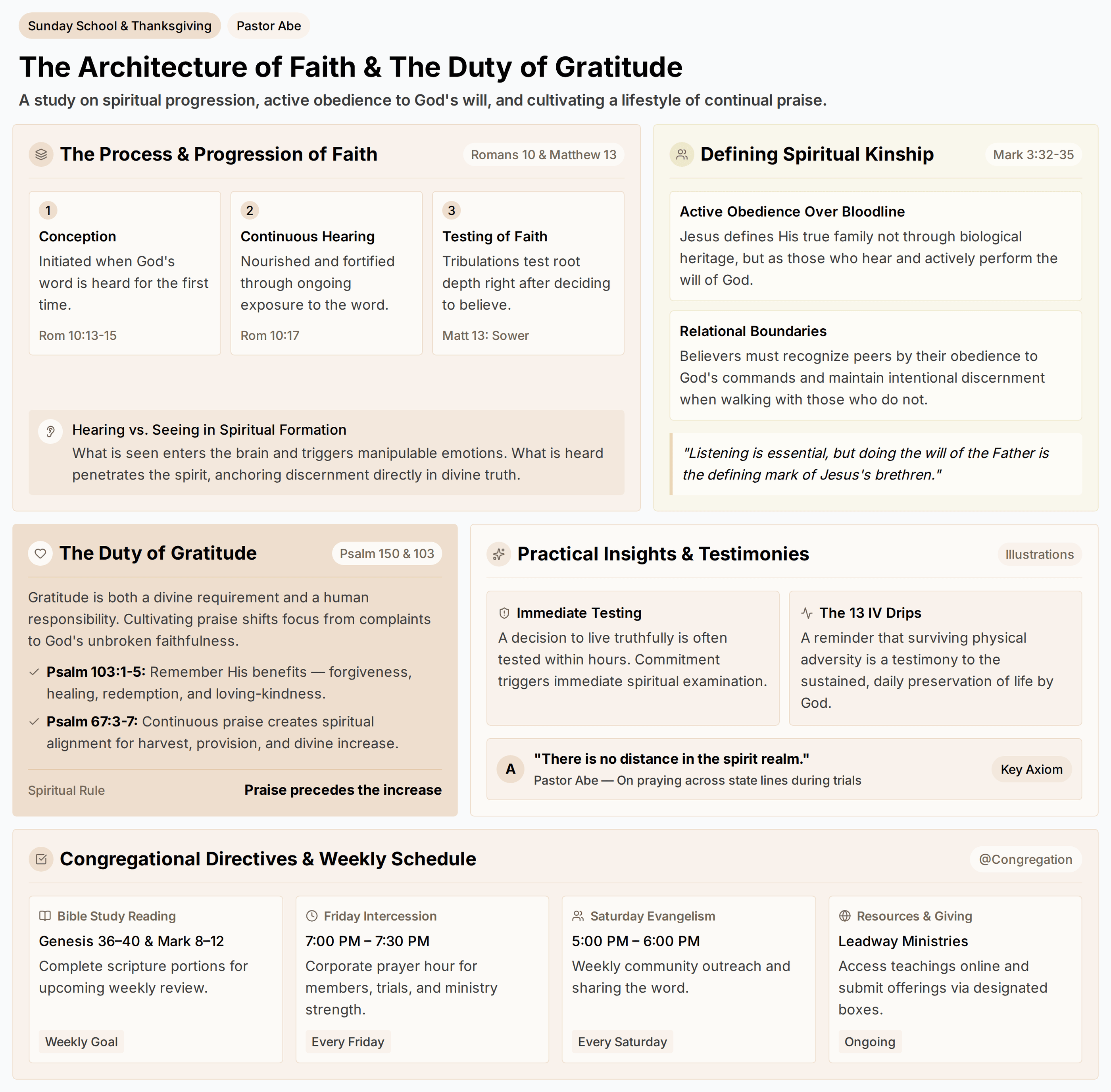
In this teaching, Pastor Abe explores the relationship between hearing God’s Word, putting it into practice, and remaining rooted when faith is tested. Using the parable of the sower and examples from everyday life, he discusses the first three stages of faith and the importance of encouraging others through challenges.
He also invites believers to cultivate a heart of thanksgiving. Drawing on the Psalms, he encourages readers to remember God’s mercy, protection, and provision and to make gratitude a regular part of their lives.
Transcript
Faith, Obedience, and a Heart of Gratitude
Hearing and Doing the Will of God
Faith is important because the Bible says that without faith it is impossible to please God. As we continue our study, let’s begin with a question: Who did Jesus refer to as His brothers and sisters?
Congregation Member: Jesus’ mother and His siblings were outside waiting for Him. When they told Him, He said that those who hear Him and do God’s will are His brothers and sisters.
Pastor Abe: Thank you. In Mark 3:32–35, Jesus looked at the people sitting around Him and spoke of them as His family. Then, in verse 35, He went further: whoever does the will of God is His brother, sister, and mother.
It does not stop with coming together to listen. We must also do the will of God. When you have friends or family members who listen to what Jesus says and put it into practice, you share something important with them.
Be discerning about the advice you receive. If someone is not following the will of God, that does not mean you have to run away from the person, but you should be thoughtful about the limits you set and the counsel you accept.
Faith Is Active
I want to continue discussing the processes, or stages, of faith. In 2023, God gave me these stages, and I shared them with another pastor. It is helpful to understand what we should do at different points in our walk of faith.
Last time, I explained that faith is spiritual and active. It is not passive; it moves and grows. For faith to produce a result, it must be active. We must put action behind what we believe.
Consider someone who has the knowledge and qualifications for a job. If that person wants to work for a company but never applies or sends in a résumé, the company may never know about them. The action is to take a step that is consistent with what the person believes.
Stage One: Faith Is Conceived
The first stage is when faith is conceived. Just as a child must first be conceived before coming into the world, faith has a beginning. Pastor Abe explained that this beginning comes through hearing.
Romans 10:13–15 asks how people can call on someone they have not believed in, how they can believe in someone they have not heard about, and how they can hear without someone sharing the message.
Paul provides an example. He encountered people who had an altar to an unknown God, and he spoke to them about the God they did not know. Someone had to tell them.
We also have opportunities to share what we know. Recently, someone asked me a biblical question, and by God’s grace I was able to answer. He appreciated the answer and said he wanted to invite his wife to learn more. My point is that people need to hear the Word, and someone needs to share it.
The first stage of faith is its conception through hearing.
Stage Two: Continuous Hearing
The second stage is continuous hearing of the Word of faith. It is not enough to hear something once and stop there. Continue listening to and learning what God’s Word says.
For example, if you hear a message about healing and believe it, continue to give attention to the Word that has encouraged your faith. Be mindful of what you listen to and of messages that contradict what you have believed.
Romans 10:17 teaches that faith comes by hearing the Word of God. The first stage is hearing; the second is continuing to hear.
Stage Three: The Test of Faith
The third stage is the testing of faith. This is when what you believe is challenged. Sometimes, after you have believed something, you may encounter circumstances that appear to point in the opposite direction.
In Matthew 13:5–6 and 20–21, Jesus speaks of seed that falls on rocky ground. It springs up quickly because the soil is shallow, but when the sun rises, it is scorched and withers because it has no root.
Jesus explains that this represents a person who hears the Word and receives it with joy, but who has no deep root. When trouble or persecution arises because of the Word, the person falls away.
Have you ever heard a message and felt excited because it sounded so good? It is good to receive the Word with joy, but the Word must also take root in us. We need to grow in our understanding and become rooted in Christ, because circumstances can come to test what we believe.
I think of the synagogue leader who came to Jesus because his daughter was sick. While Jesus was on the way, another situation required His attention, and news came that the girl had died. The people told her father not to trouble Jesus any longer. Jesus encouraged him not to be afraid, but to believe.
As I understand it, this also illustrates that there is no distance in the spiritual realm. God can work in a situation even when we are physically far away.
I have experienced tests of faith myself. At one point, I decided that I would no longer lie or help anyone else lie. Within a day, someone called and asked me to help tell a lie. I said no. What I had just decided was quickly put to the test.
On another occasion, I was in Illinois when I heard about a five-year-old boy in another state who was having seizures. I asked his mother to contact me so that I could pray. Afterward, she told me that he was doing well. About a month later, she called to say he had experienced another seizure. She told me that previously they had happened at least twice a month. I prayed again, and, as I understood it, the situation ended after that. I share this as an example of why I believe distance does not limit prayer.
God gave me four stages of faith. Today we have discussed the first three; we will continue the study, including Abraham’s experience of tested faith, another time.
A Question: What About Seeing?
Pastor Abe: We have said that faith is conceived through hearing. What about seeing? Can faith develop through what we see?
Congregation Member: What if you saw Jesus perform a miracle? You would be seeing it.
Pastor Abe: Yes, faith can develop through what we see. But why does the Bible emphasize that faith comes by hearing?
Congregation Member: In my opinion, what we hear goes to our mind, soul, and spirit. From there it can develop and lead to action.
Pastor Abe: That is a helpful answer. What we see can affect our thoughts and emotions. We should be careful not to base our faith only on emotion, because appearances and emotions can be manipulated.
Someone could act in a way that makes you think they need help, when they may actually be trying to gain your sympathy. We need discernment. That is why I emphasize hearing and continuing to hear the Word of God.
Supporting People Through Trials
When someone comes to Jesus and begins to face opposition, that person may need encouragement and follow-up. Supporting someone is not always about giving money; sometimes the person needs advice, someone to answer questions, or someone to stand with them.
I remember a story of a young woman whose parents rejected her after she accepted Jesus. She returned to her former way of life, and later she died in an accident. Her parents eventually came to faith through the same group that had shared the message with her.
I believe the young woman may not have received enough help during that difficult time. Imagine being rejected by your own parents. A person facing that kind of trial needs support. When we lead someone to Christ, we should follow up and be available to help.
Peter also faced a serious test. Jesus told Peter that He had prayed for him, and Peter went on to deny Jesus three times. There can be situations that put great pressure on a person’s faith, so we need prayer and support.
I also think of Judas Iscariot. In my teaching, I see his story as a reminder of the need for help when a person is struggling. We should be careful not to assume that we cannot fall, and we should ask God to uphold us during difficult times.
God’s Request and Our Duty: Thanksgiving
God requires something from us: a heart of praise and thanksgiving.
Psalm 150 calls us to praise God for His mighty acts and His greatness. It ends by calling everything that has breath to praise the Lord. Our hearts should be grateful to God; we should not receive His benefits and never return thanks.
Often, when something happens, our first reaction is to complain. If someone asks how we are doing, we may immediately list all the things going wrong. It is understandable to speak about our difficulties, but we should also remember to thank God for what we have.
I began thinking more deliberately about gratitude when I considered God’s protection. Not everyone who goes out in the morning returns home safely. Some experience accidents or illness. A man I spoke with told me that he had been very sick and had needed 13 IV drips. Hearing about his experience reminded me how serious illness can be.
Since 2021, when I go out and return home, I have made it a practice to kneel and thank God for bringing me back safely. We should learn to thank God more and complain less.
Think about it as a parent. If you have done many things for your child, but the child focuses only on the one thing you have not yet done, you may feel that your efforts are not appreciated. In the same way, let us remember what God has already done rather than focusing only on what we are still waiting for.
Do Not Forget His Benefits
Psalm 103:1–5 calls us to bless the Lord and not forget His benefits. It speaks of forgiveness, healing, redemption from destruction, lovingkindness, tender mercies, and the good things with which God satisfies us.
We can become forgetful of what God has done. The Bible also speaks about not being a forgetful hearer, but continuing in what we have learned. Let us remember God’s forgiveness and mercy, His redemption, His care, and His provision.
When we remember these things, we have reasons to praise Him. We can also thank Him in faith for what we are still trusting Him to do.
Gratitude and God’s Blessing
Are there blessings in being grateful to God? I believe there are. When we show gratitude for what God has given us, He can do more.
Psalm 67:3–7 calls the people to praise God and speaks of the earth yielding its increase and God blessing His people. I see in this passage an encouragement to praise God and to live diligently and faithfully.
Be committed to what you do. Pay attention to your responsibilities, and be grateful to God for what He has given you. Take time to remember His benefits, count your blessings, and give Him thanks.
Scripture References
Mark 3:32–35 — Jesus identifies those who do God’s will as His brother, sister, and mother. Pastor Abe emphasized that listening to the Word should lead to obedience.
Romans 10:13–17 — Paul connects hearing, believing, and calling on the Lord. Pastor Abe used this passage to explain the beginning of faith and the importance of continuing to hear God’s Word.
Matthew 13:5–6, 20–21 — In the parable of the sower, the seed on rocky ground represents someone who receives the Word with joy but falls away when trouble or persecution comes. Pastor Abe used this picture to encourage believers to become rooted in Christ.
Acts 17:22–34 — Paul speaks to the people of Athens about the God they had described as unknown. Pastor Abe used this example to illustrate the importance of someone sharing the message so that others can hear.
Mark 5:35–43 — Jesus encourages a synagogue leader to believe after hearing that his daughter has died. Pastor Abe referred to this story while discussing faith in the face of difficult circumstances.
Luke 22:31–34 — Jesus tells Peter that He has prayed for him and speaks of Peter’s coming denial. Pastor Abe used Peter’s experience to emphasize the need for prayer and support during trials.
Psalm 150:1–6 — This psalm calls everything that has breath to praise the Lord. Pastor Abe presented praise and thanksgiving as a duty of a grateful heart.
Psalm 103:1–5 — The psalm calls us to remember the Lord’s benefits, including forgiveness, healing, redemption, and mercy. Pastor Abe encouraged the congregation not to forget what God has done.
Psalm 67:3–7 — The psalm calls the peoples to praise God and speaks of the earth yielding its increase and God’s blessing. Pastor Abe connected this passage with gratitude, diligence, and God’s provision.
Summary Photo